0
Items
$0.00

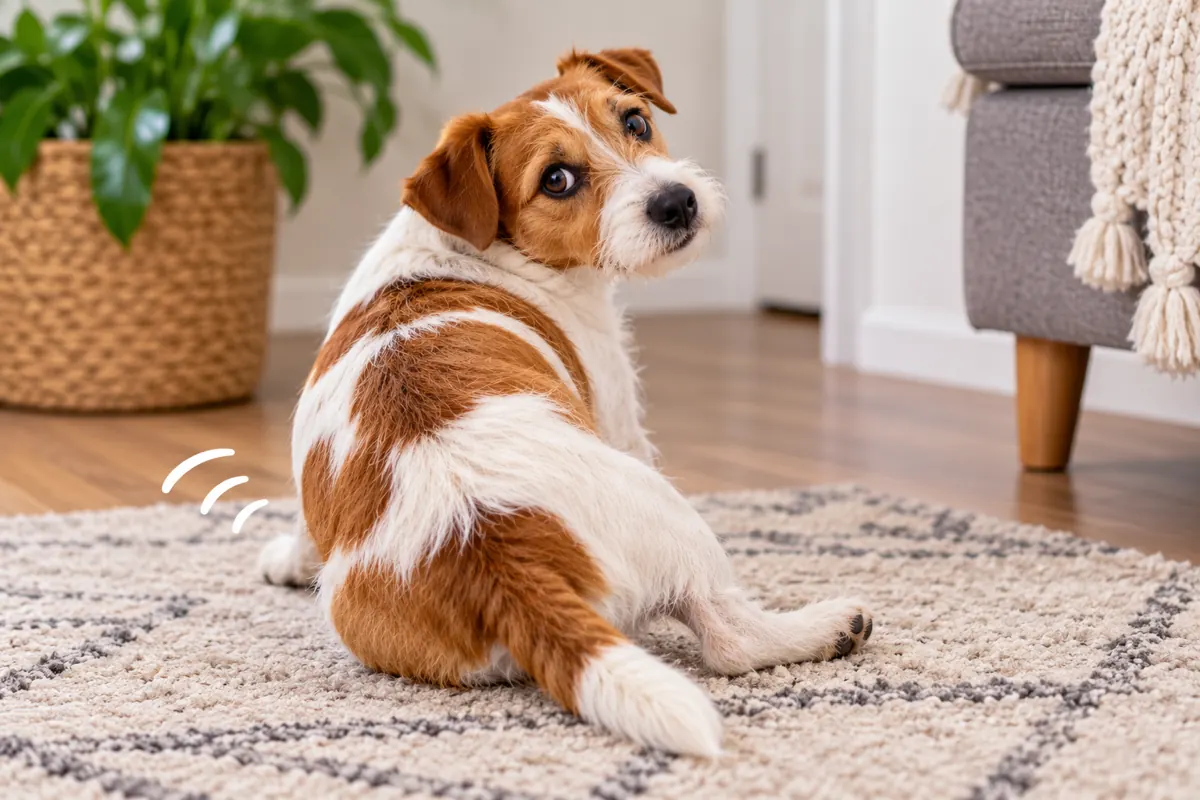
We’ve all seen it. Your dog sits down, lifts its back legs and starts dragging its bottom across the carpet like a little furry vacuum cleaner.
Usually just after you’ve cleaned the floors. Or worse, when you’ve got visitors!
But while bottom scooting might look hilarious, there’s usually a reason behind it.
And no, your dog isn’t trying to polish the carpet.
Dogs have two small sacs, commonly called anal glands, located just inside their bottom.
These sacs contain a strong-smelling fluid that normally empties when your dog passes a firm stool.
Sometimes, however, the sacs don’t empty properly. They can become overly full, irritated, blocked or even infected.
Signs of anal gland trouble can include:
If your dog is scooting repeatedly, it’s worth having your vet check their anal glands.
Important: Don’t attempt to squeeze or empty your dog’s anal glands yourself unless your vet has shown you how and advised you to do so. Incorrect handling can cause pain or injury.
Intestinal parasites can sometimes cause irritation around a dog’s bottom.
Tapeworm segments, for example, may look like tiny grains of rice around the anus, in your dog’s bedding or in their poo.
However, not every scooting dog has worms, and not every dog with worms scoots.
If you suspect parasites, speak to your vet about an appropriate worming treatment and whether a faecal test is needed.
Just like itchy paws and ears, the skin around your dog’s bottom can become irritated.
Possible causes include environmental allergies, skin infections, contact irritation or other skin conditions.
You might notice redness, licking, scratching or discomfort in other areas too.
If the scooting keeps happening, it’s worth investigating rather than assuming it’s always the anal glands.
Sometimes the explanation is much simpler.
A little dried poo, a clump of fur or something caught around the anus can make your dog uncomfortable.
Long-haired dogs are particularly prone to this.
Have a gentle look under the tail. If there’s a little mess caught in the fur, carefully cleaning the area with lukewarm water may solve the problem.
Avoid pulling anything protruding from the anus, particularly string or thread, as this could cause serious internal injury.
Diet can sometimes play a role in anal gland health.
Normally, passing a well-formed stool helps put pressure on the anal sacs, encouraging them to empty.
Dogs that regularly pass very soft stools may not get the same natural pressure.
However, anal gland problems can occur even when a dog produces perfectly normal stools.
A balanced diet that suits your individual dog is important, but switching foods or adding fibre won’t necessarily fix an existing anal gland problem.
What about raw-fed dogs?
Some raw-fed dogs produce smaller, firmer stools, particularly when their meals contain bone.
But raw feeding doesn’t guarantee healthy anal glands, and excessively hard stools can cause discomfort or constipation.
The goal is comfortable, regular bowel movements — not the hardest poo possible!
An occasional scoot after toileting may simply mean your dog is cleaning themselves.
But repeated scooting deserves attention.
Book a veterinary appointment if you notice:
Seek prompt veterinary attention if your dog has significant pain, swelling, bleeding, pus or an open wound beside the anus. These can be signs of an anal gland abscess or another serious problem.
Not every cause is preventable, but a few simple habits can help.
And remember, not every dog needs routine anal gland expression. In fact, unnecessary squeezing may cause irritation.
Bottom scooting might be one of the funniest things our dogs do, but it’s often their way of telling us something doesn’t feel quite right.
Whether it’s full anal glands, irritation, parasites or simply a messy bottom, understanding the cause is the best way to help.
And if your dog decides to demonstrate their bottom-scooting technique across your freshly cleaned carpet?
Well, at least you know they’re not auditioning for a job as a floor polisher!
From the team at The Cats & Dogs Dinner Company 🐾
Helping Kiwi pets live happy, healthy lives — even when the questions are a little embarrassing!