0
Items
$0.00

Ticks are tiny parasites that can cause big worries for pet owners. Whether your dog loves exploring the bush, your cat wanders around the garden, or your pets enjoy long walks through grassy areas, it’s worth knowing what ticks look like, where they hide and how to protect your furry family members.
At The Cats & Dogs Dinner Company, we believe that understanding the parasites our pets may encounter is an important part of keeping them happy and healthy.
Ticks are commonly associated with areas of vegetation where they can find animals to feed on. They may be encountered in:
In New Zealand, the cattle tick, also known as the bush tick (Haemaphysalis longicornis), is an important species affecting domestic animals. It is found mainly in warmer parts of the country, including much of the North Island and some areas of the upper South Island.
Ticks aren’t just a concern for dogs. Cats, livestock and occasionally people can also be bitten.
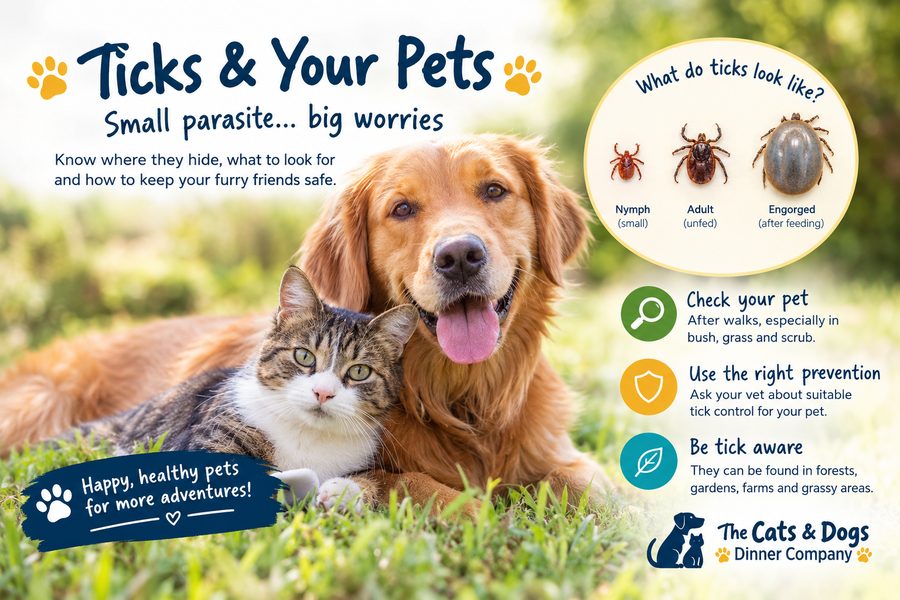
Ticks are small, eight-legged parasites related to spiders. They can be surprisingly difficult to spot, particularly when they’re moving through thick fur.
Depending on their life stage, ticks may look like tiny red or dark specks. An unfed adult may resemble a small, flattened, brown seed. Once it has attached and fed on blood, it can swell considerably and become greyish or blue-black in colour.
A tick attached to your pet can sometimes be mistaken for a skin lump or small growth. Look closely, but if you’re unsure what you’re seeing, ask your veterinarian to check it.
After walks, outdoor adventures or time spent in long grass, take a few minutes to check your pet thoroughly.
Pay particular attention to:
Run your fingers gently through your pet’s coat, feeling for small, firm bumps on the skin. Remember that young ticks can be extremely small, so a quick glance over the coat may not be enough.
It’s a good habit to check your pet after every outdoor adventure, especially if they’ve been exploring off the beaten track.
When a tick attaches to an animal, it feeds on its blood. This can cause irritation, redness, soreness and scratching around the bite site. Scratching or chewing may damage the skin and sometimes lead to a secondary infection.
Heavy infestations can cause significant blood loss, particularly in small or young animals.
Some tick species overseas can transmit serious diseases. New Zealand has a different tick population, and the risks are not the same as those in every other country. However, tick-associated animal health concerns do exist, so prevention and prompt veterinary advice remain important.
Contact your veterinarian if your pet has a heavy infestation, seems unwell after a tick bite, develops unusual weakness or has a bite site that becomes swollen, painful or infected.
First, don’t panic. If you find an attached tick, remove it carefully or ask your veterinarian to do so if you’re unsure how.
Avoid burning the tick, applying oils or household chemicals, or trying to force it off with your fingers. If possible, keep the removed tick in a sealed container in case your veterinarian needs to identify it.
The best approach combines regular checks with appropriate parasite prevention.
Consider these simple habits:
Always use products specifically suitable for the animal you’re treating. Some dog parasite products can be highly toxic to cats, so never assume a treatment is safe for both.
There is interest in natural options for controlling parasites, including diatomaceous earth. This fine powder can damage the protective outer layer of certain insects and other arthropods, helping them lose moisture.
However, results depend on the pest and the conditions. Evidence that diatomaceous earth can help control fleas does not mean it will reliably prevent ticks from attaching to pets.
Fine powder can also irritate the eyes and respiratory tract if inhaled. For these reasons, don’t rely on diatomaceous earth as a tick repellent or a substitute for an appropriate tick preventative.
If you’re considering a natural product for your pet, check that it is suitable for the intended use and ask your veterinarian if you’re uncertain.
Our pets love exploring the world around them, and we want them to enjoy those adventures safely. A few minutes spent checking their coat after an outing can help you spot ticks early and deal with them before they cause further problems.
If you ever find a tick on your dog or cat and aren’t sure what to do, your veterinarian is the best person to advise you.
From all of us at The Cats & Dogs Dinner Company, here’s to happy adventures, healthy pets and plenty of tail wags! 🐾
Further information: